
Schoolcraft County Circuit Court Overview
Michigan runs what it calls "One Court of Justice." The state supreme court sits at the top, and every trial court below it is part of one system. Local work is still split among three trial courts. In Schoolcraft County that work is led by the 11th Judicial Circuit Court, the court of general jurisdiction for the county.
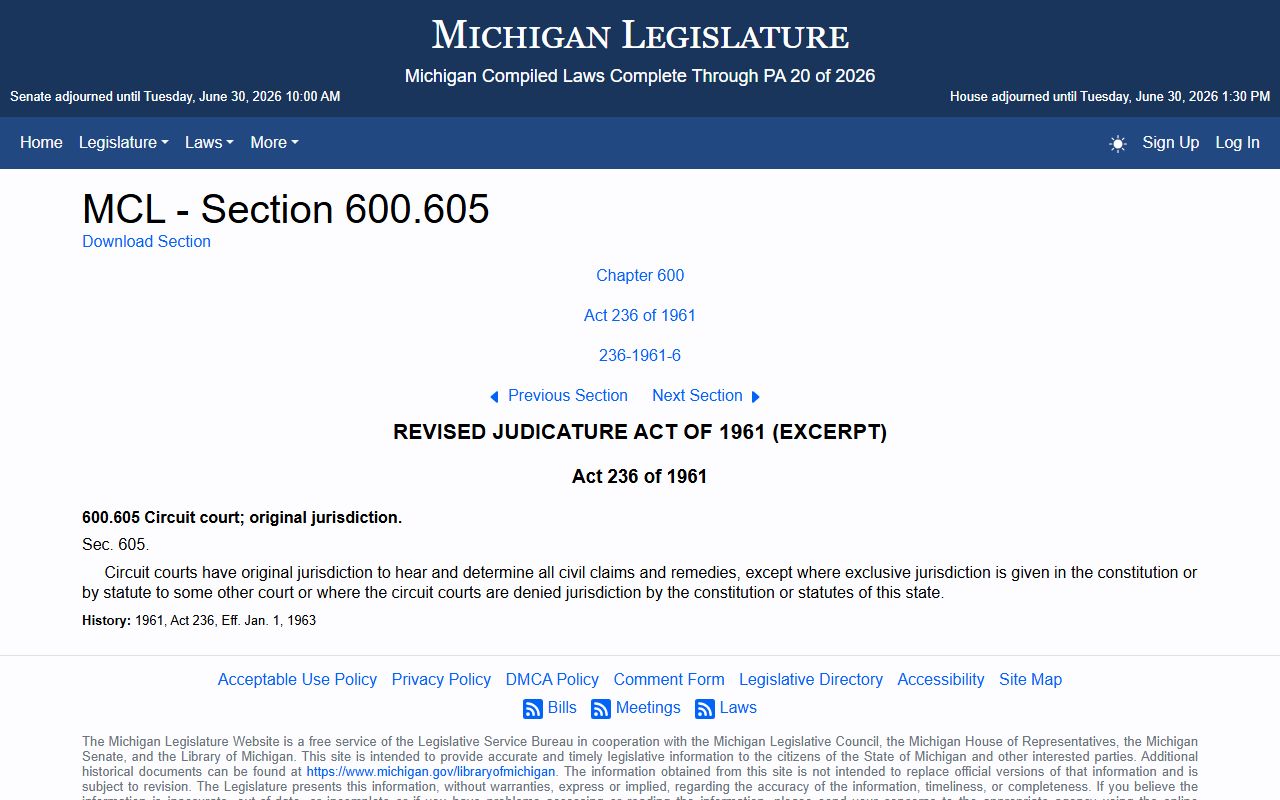
General jurisdiction means the circuit court can hear almost any case that another court is not specifically assigned to handle. Michigan's circuit court jurisdiction statute, MCL 600.605, gives circuit courts original jurisdiction over civil claims and remedies unless a statute places them elsewhere. In practice the 11th Circuit hears felony cases after a district-court bindover, divorce and domestic relations matters, civil suits above the statutory limit, equity cases, and personal protection orders.
Judge Brian Rahilly presides over the circuit bench, with a term running through the end of 2026. The elected Schoolcraft County Clerk and Register of Deeds also serves as Clerk of the Court, so a felony file, divorce judgment, or civil complaint is kept and certified through that office.
11th Judicial Circuit Court
Judge: Brian Rahilly
Clerk of the Court: Beth A. Edwards
Schoolcraft County Courthouse, Room 164
300 Walnut Street
Manistique, MI 49854
906-341-3655
Clerk's Office: 906-341-3618
Trial Courts in Schoolcraft County
Three trial courts share the Schoolcraft County Courthouse at 300 Walnut Street in Manistique. Each one holds a defined slice of the county's caseload, and each has its own clerk, phone line, and room number. Reaching the right court depends on the case type, not the address, since all three share the same building.
The county's own courts directory names the judges, clerks, and staff for each bench. The overview of the 11th Judicial Circuit Court on the Schoolcraft County website lists the presiding judge, the clerk, the room, and a direct link into the state case-search system.
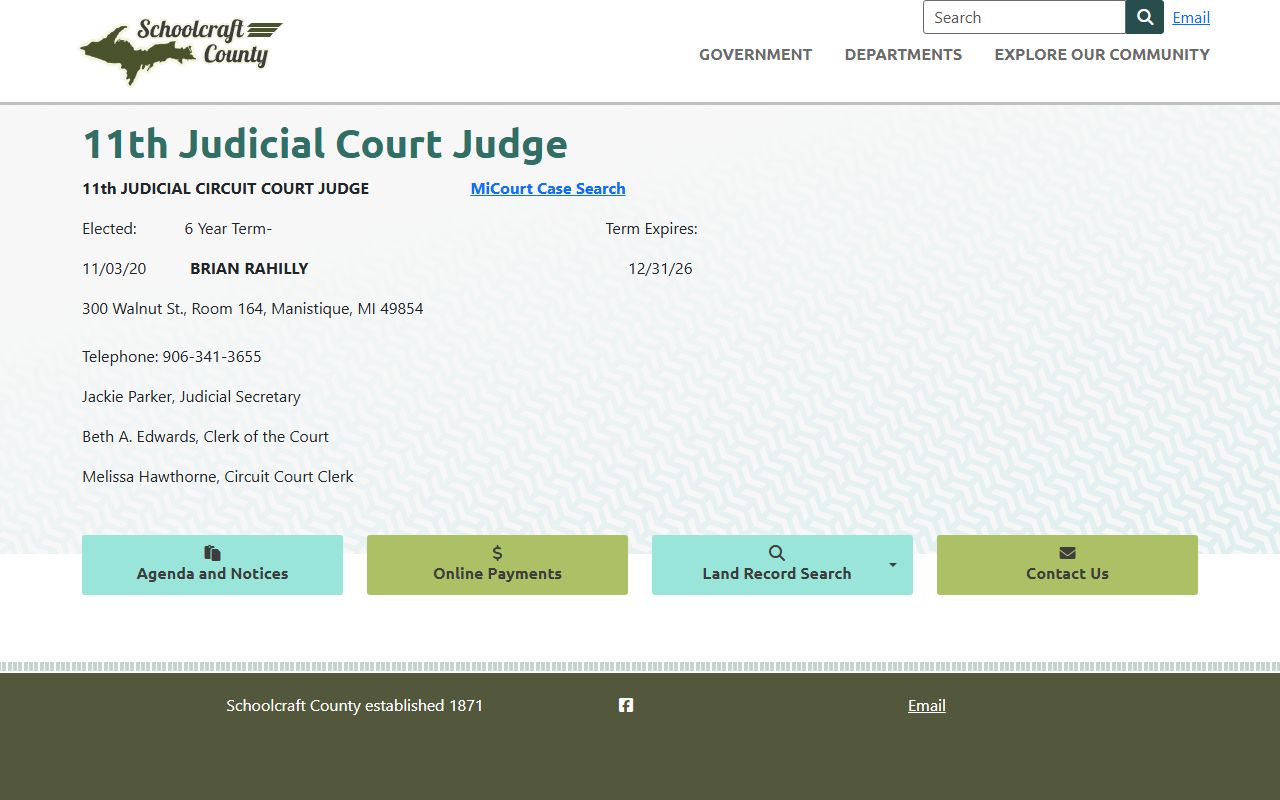
The table below gathers the three Schoolcraft County trial courts in one place, with the addresses, phone numbers, key officials, and the matters each court decides.
| Court | Address | Phone | Officials / Staff | Jurisdiction |
|---|---|---|---|---|
| 11th Judicial Circuit Court | 300 Walnut St., Room 164, Manistique, MI 49854 | 906-341-3655 | Judge Brian Rahilly (term to 12/31/2026); Clerk of the Court Beth A. Edwards; Circuit Court Clerk Melissa Hawthorne | Felonies after bindover, divorce and domestic relations, civil claims over $25,000, equity, personal protection orders, and appeals from lower courts |
| 93rd Judicial District Court | 300 Walnut St., Room 135, Manistique, MI 49854 | 906-341-3630; fax 906-341-8006 | Judge Charles Nebel (term to 12/31/2030); Court Clerk Brian Marks; Probation Officer Dave Gould | Traffic and civil infractions, misdemeanors, small claims and civil under $25,000, landlord-tenant, and preliminary felony stages |
| 5th Judicial Probate Court | 300 Walnut St., Room 129, Manistique, MI 49854 | 906-341-3641; juvenile 906-341-3644 | Judge Charles C. Nebel; Register of Probate Marnie Hoezee | Estates, wills, trusts, guardianships, conservatorships, protected individuals, and juvenile matters |
Notice that Judge Charles Nebel is listed for both the district and probate benches. That kind of shared judicial service is common in Michigan's smaller Upper Peninsula counties, where a low case volume does not support a separate judge for every court.
Note: Circuit court files and the district and probate courts share the same courthouse, but each keeps its own records, so confirm the case type before you call.
How Felony Cases Reach the Circuit Court
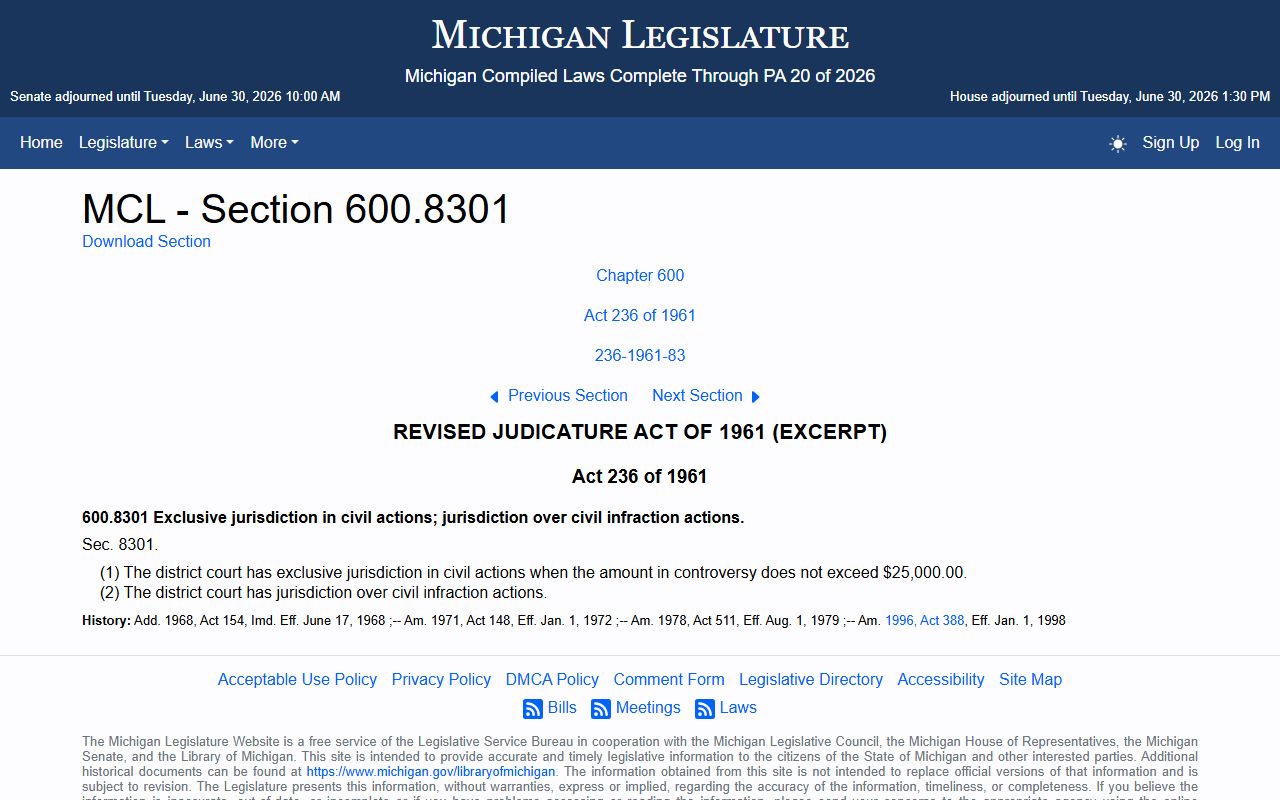
A felony does not start in the circuit court. It begins in the 93rd District Court, which handles the early stages of every felony charge in Schoolcraft County. The district court's authority over these early steps and over lesser matters comes from Michigan's district court jurisdiction statute.
That statute, MCL 600.8301, sets the district court's limits and frames where a felony case must pause before it can move up. The screenshot below shows the district court jurisdiction law that governs the front end of a Schoolcraft County Circuit Court felony matter.
Once a judge finds probable cause, the felony is "bound over" and transferred to the 11th Circuit Court for the rest of the case. The steps below trace that path from arrest to sentence.
- A complaint and warrant open the case, followed by arrest or a court summons.
- The defendant is arraigned in the 93rd District Court on the felony charge, and bond is addressed.
- A probable cause conference and preliminary examination test whether the case should proceed.
- The district judge binds the case over to the 11th Circuit Court when probable cause is found.
- The circuit court holds arraignment on the information, then pretrial, plea talks, or trial.
- Sentencing follows a conviction or plea, and either side may appeal to the Michigan Court of Appeals.
- Bindover
- The transfer of a felony from district court to circuit court after a judge finds probable cause that a crime was committed.
- Information
- The formal charging document filed in circuit court that replaces the district-court complaint after bindover.
- Arraignment
- The court hearing where charges are read, rights are explained, and a plea is entered.
Civil Jurisdiction and the $25,000 Line
The dividing line between the circuit court and the district court on the civil side is a dollar amount. The district court hears civil actions when the amount in dispute does not top $25,000. The circuit court takes the larger cases, along with equity claims and matters no other court is given.
This split flows from the circuit court's broad grant of original jurisdiction. The official text of that grant appears in the Michigan Legislature's posting of the circuit court jurisdiction statute, shown below.
Beyond money claims, the circuit court is the venue for divorce and family matters, equitable relief like injunctions, and personal protection orders. Its family division also reviews cases that touch on children and support, working with the Friend of the Court office in the same courthouse. Divorce judgments, larger money disputes, and PPO files therefore live with the 11th Circuit Court, and certified copies come through the Schoolcraft County Clerk of the Court.
Important: A civil case filed for slightly more or less than $25,000 may belong to a different court, so the amount claimed decides whether the circuit or district court hears it.
Circuit Court vs District Court vs Probate Court
The three Schoolcraft County trial courts rarely overlap. Each was built for a different kind of case, and the differences in jurisdiction, dollar limits, and subject matter are easy to see side by side. The comparison below sorts the most common questions people ask before they file or search.
| Circuit Court | District Court | Probate Court | |
|---|---|---|---|
| Local Court | 11th Judicial Circuit | 93rd Judicial District | 5th Judicial Probate |
| Civil Limit | Over $25,000 | Up to $25,000 | Estate and trust value, no fixed cap |
| Criminal Jurisdiction | Felony case files after bindover | Misdemeanors and early felony stages | Juvenile delinquency and protective cases |
| Family Cases | Divorce, custody, support, PPO | Landlord-tenant only | Guardianship and conservatorship |
| Governing Statute | MCL 600.605 | MCL 600.8301 | MCL 700.1302 |
The probate court's reach comes from its own exclusive-jurisdiction statute, MCL 700.1302, which covers deceased estates, trusts, guardianships, conservatorships, and protective proceedings. Estate and guardianship files never move to the circuit court, and felony trials never move to probate. Matching the case to the court first saves a wasted trip to the wrong counter.
How a Case Moves Through the Schoolcraft County System
Michigan's unified structure gives every case a clear path upward. A matter usually starts in one of the two lower trial courts, moves to the circuit court when the stakes rise, and can be reviewed by the state appellate courts. The single-line flow below shows the ladder from the local bench to the top of the state system.
Case flow: District Court › Circuit Court › Michigan Court of Appeals › Michigan Supreme Court
Not every case climbs the whole ladder. A traffic ticket or small claim may end in the district court. A felony passes from the district court to the circuit court through bindover. Only cases that are appealed reach the Michigan Court of Appeals, and the Michigan Supreme Court hears a small share of those by choosing which appeals to review.
The circuit court also acts as an appeals court itself in limited situations. It can review certain district court and administrative agency decisions before any case ever reaches the state's intermediate appellate court.
Problem-Solving Courts Serving Schoolcraft County
Schoolcraft County shares two problem-solving courts with its Upper Peninsula neighbors. These programs are treatment-focused dockets that aim to address the root causes behind repeat cases, and both run through the regional district court structure rather than a stand-alone court.
- Eastern Upper Peninsula Mental Health Court, a regional adult mental health court serving Alger, Luce, and Schoolcraft Counties through the 93rd District Court.
- Schoolcraft/Alger Hybrid DWI/Drug Court, a regional problem-solving docket serving Schoolcraft and Alger Counties for substance-use and impaired-driving cases.
Michigan's statewide problem-solving courts report confirms both programs. Because participation records are sensitive, they do not appear in ordinary public case searches, and referral or eligibility questions go to the 93rd District Court. A successful completion can change how the underlying case is resolved, which is why these dockets matter to defendants who qualify.
Note: Problem-solving court participation is confidential, so program records will not show up in a routine circuit or district court case lookup.
E-Filing and Online Case Search
Michigan handles court filing and public case lookup through two separate statewide systems. MiFILE, built on TrueFiling, is the electronic filing platform, while MiCOURT Case Search is the free public index for participating courts. The circuit court page links directly into the MiCOURT route for the local court so a searcher does not have to scan every court in the state.
The state's MiFILE available-courts list confirms e-filing for the Schoolcraft County 93rd District Court and the Schoolcraft County Probate Court. A separate circuit-court e-filing entry did not appear in the captured list, so anyone planning to e-file a circuit matter should verify current circuit e-filing status with the Clerk of the Court before submitting. The table sums up where e-filing stands today.
| Court | MiFILE E-Filing |
|---|---|
| 93rd District Court, Manistique | Confirmed |
| Schoolcraft County Probate Court | Confirmed |
| 11th Circuit Court | Verify with the clerk at 906-341-3618 |
For a case already on file, MiCOURT shows the index level of a record, which means case number, party names, and the register of actions. It is not a document library. Under Michigan court rules, courts do not post document images online, so full or certified copies come from the clerk. A broader walk-through of the search steps and what the results contain lives with the county court records resources.
Federal Court for Schoolcraft County
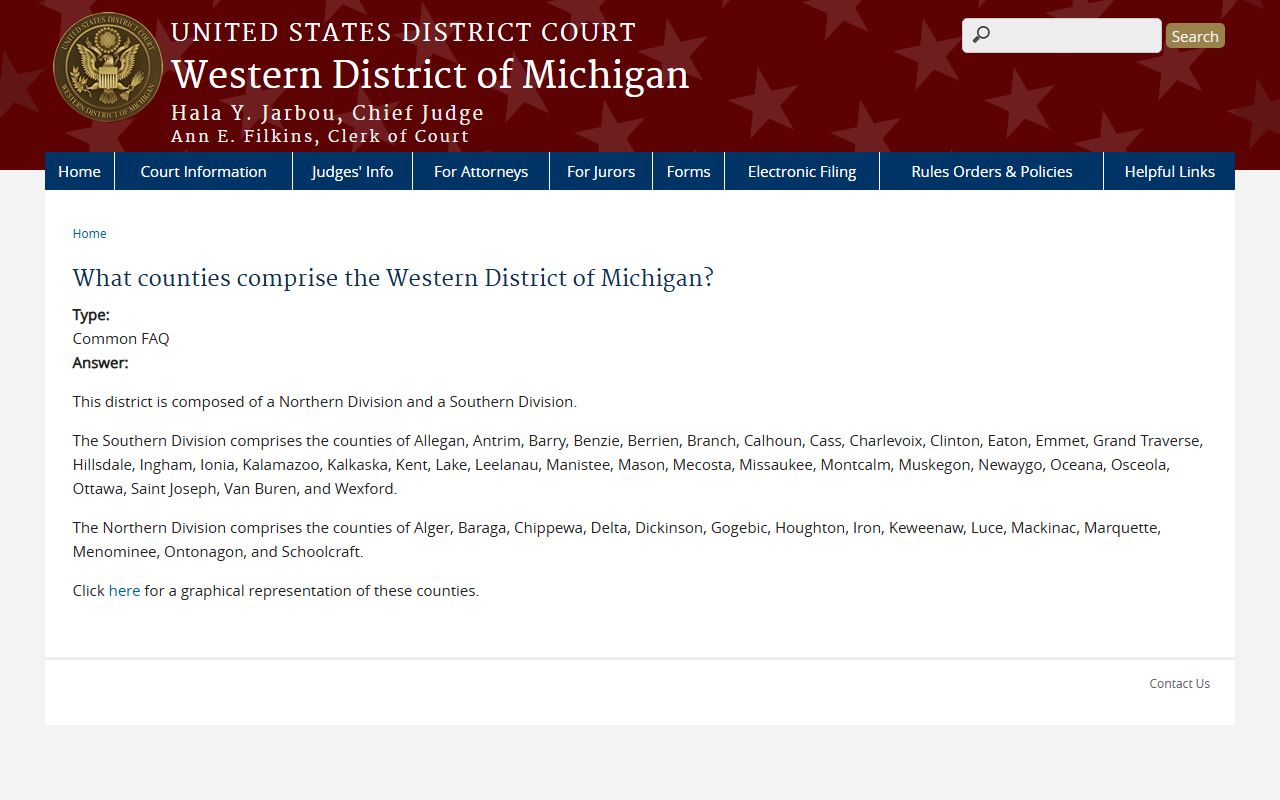
Not every case involving a Schoolcraft County resident belongs to the state circuit court. Federal crimes, federal civil rights suits, and other federal claims are heard in a separate system. Schoolcraft County falls inside the Northern Division of the U.S. District Court for the Western District of Michigan.
The court's own coverage page settles which counties it serves. The Western District of Michigan county list, shown below, includes Schoolcraft County in the Northern Division, and the Marquette federal courthouse is the nearest federal location for Upper Peninsula residents.
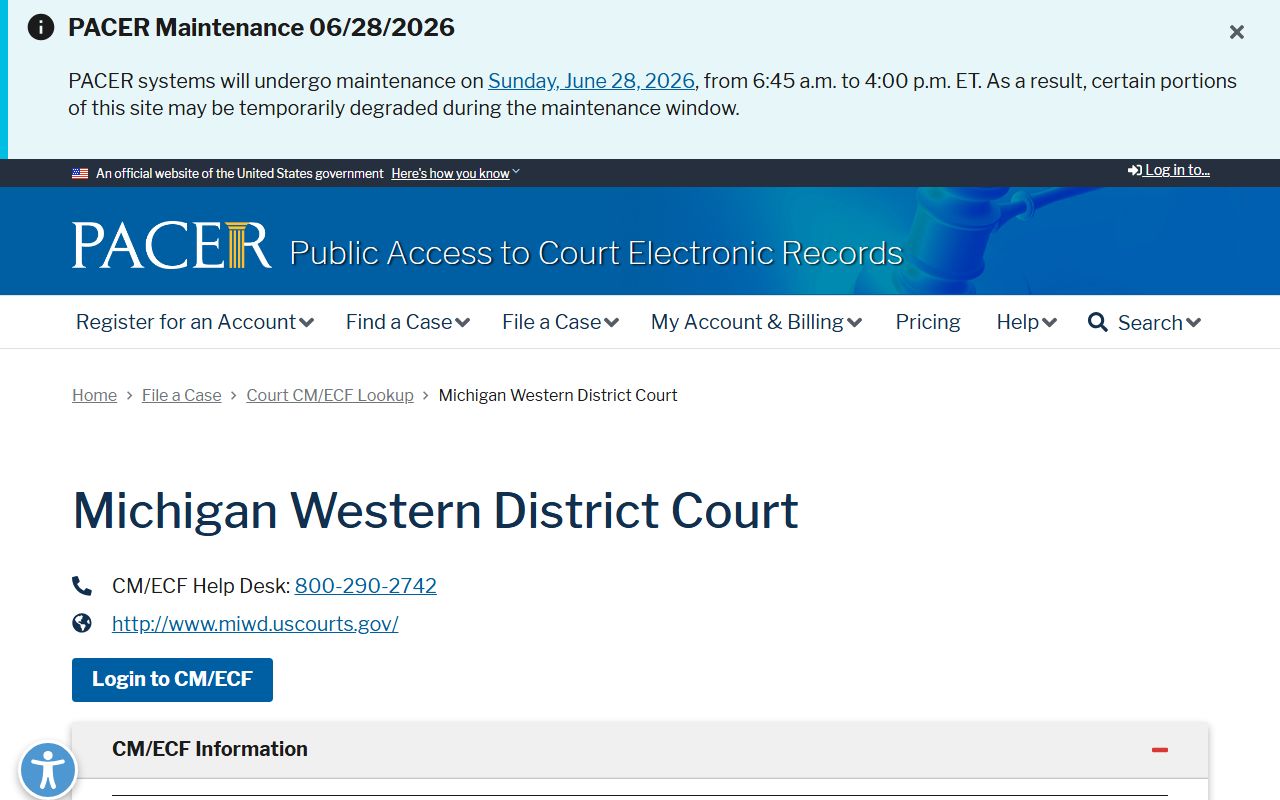
Federal dockets are not in MiCOURT. They are searched and filed through PACER and the court's CM/ECF system instead. The PACER CM/ECF lookup for the Western District, pictured here, provides the official portal and courthouse contacts for federal case access.
Bankruptcy filings from Schoolcraft County go to the U.S. Bankruptcy Court for the Western District of Michigan, which uses its own CM/ECF system. Keeping the state and federal tracks separate avoids the common mistake of hunting for a federal matter in the county circuit court files.
Appeals From the Schoolcraft County Circuit Court
An appeal is a request for a higher court to review a decision, not a new trial. Appeals from the 11th Circuit Court in most civil and criminal matters go to the Michigan Court of Appeals, the state's intermediate appellate court. The Michigan Supreme Court sits above it and reviews only a limited set of cases it chooses to hear.
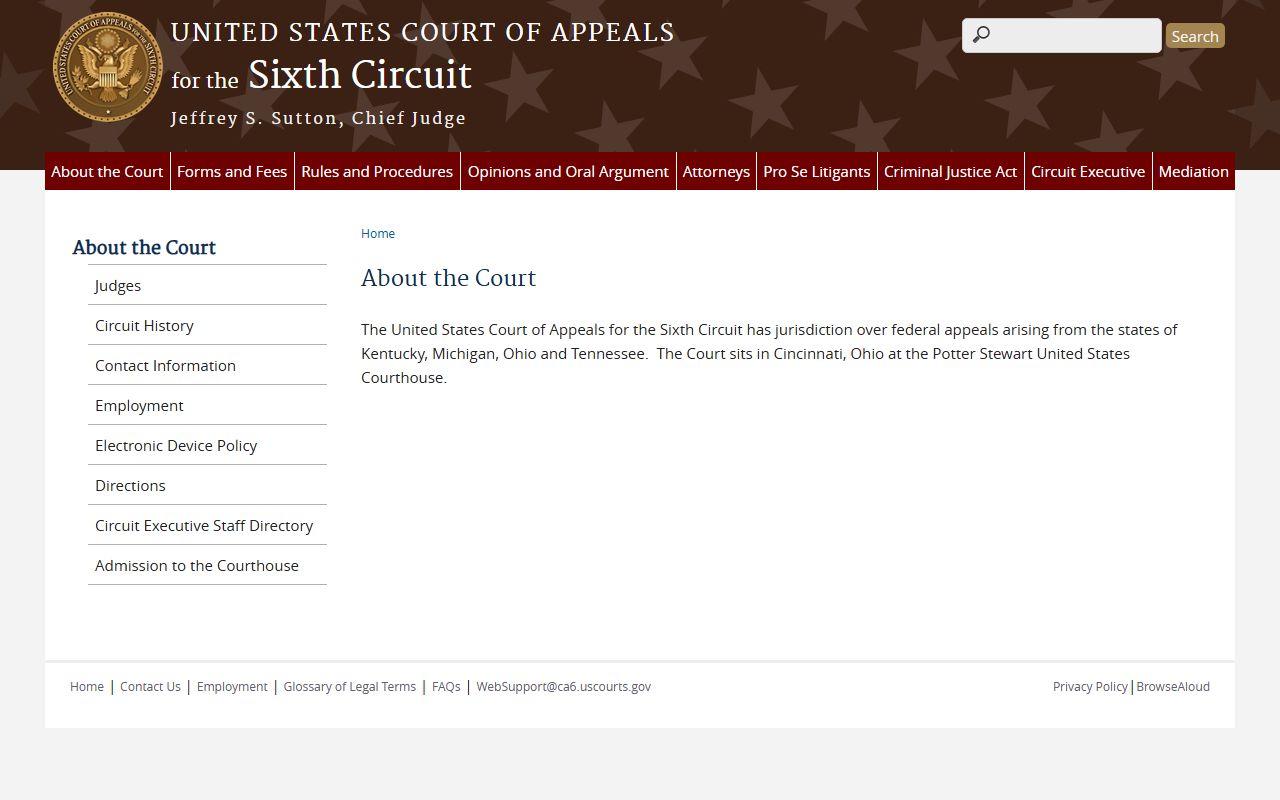
Federal cases follow a different appeals road. A decision from the Western District of Michigan is reviewed by the U.S. Court of Appeals for the Sixth Circuit. The Sixth Circuit's court information page, shown below, confirms its jurisdiction over Michigan, along with Kentucky, Ohio, and Tennessee.
So a Schoolcraft County matter can travel two very different appellate paths. State cases climb from the circuit court to the Michigan Court of Appeals and possibly the Michigan Supreme Court. Federal cases move from the Western District to the Sixth Circuit. Knowing which system a case belongs to points a person to the right court from the start.