
Schoolcraft County Arrest Records and Court Charges
An arrest record documents the arrest event itself. It shows who was taken into custody, which agency made the arrest, and the booking that follows at the jail. In Schoolcraft County most arrests run through the Sheriff's Department and jail at 300 Main Street in Manistique. That booking side, including who is currently held and on what bond, lives on the custody roster rather than in a court file. For the jail side of a name, the Schoolcraft County inmate records page walks through how to check custody status by phone since the county does not publish an online roster.
A court charge record is a different document. After an arrest, the Prosecuting Attorney reviews the police report and decides what, if anything, to file. Those court charges after arrest become part of the case the clerk maintains, and they move through the district and circuit courts as the matter proceeds. A charge is narrower than the full case file. It is the specific offense or set of offenses filed against a person, and it can appear in district court first, before any circuit case exists. The complete case file, including pleas, disposition, and sentence, sits in the county's criminal court records.
Who Files Charges After a Schoolcraft County Arrest
In Michigan the office that files criminal charges is the Prosecuting Attorney, not a district attorney. For Schoolcraft County the elected prosecutor is Timothy Noble, whose office sits in Room 209 of the courthouse. The prosecutor screens arrests, reviews the evidence, and decides whether the facts support a charge and at what level. Police make arrests, but they do not set the formal charges that end up on the court record. That authority belongs to the prosecutor.
The prosecutor's decision is why an arrest does not always turn into a charge, and why the charge filed can differ from the offense listed on the arrest. Weak evidence, a missing element, or a witness problem can all change the outcome. The Schoolcraft County Prosecuting Attorney office page lists the prosecutor, address, and phone line for charging questions, along with victim and child support staff.
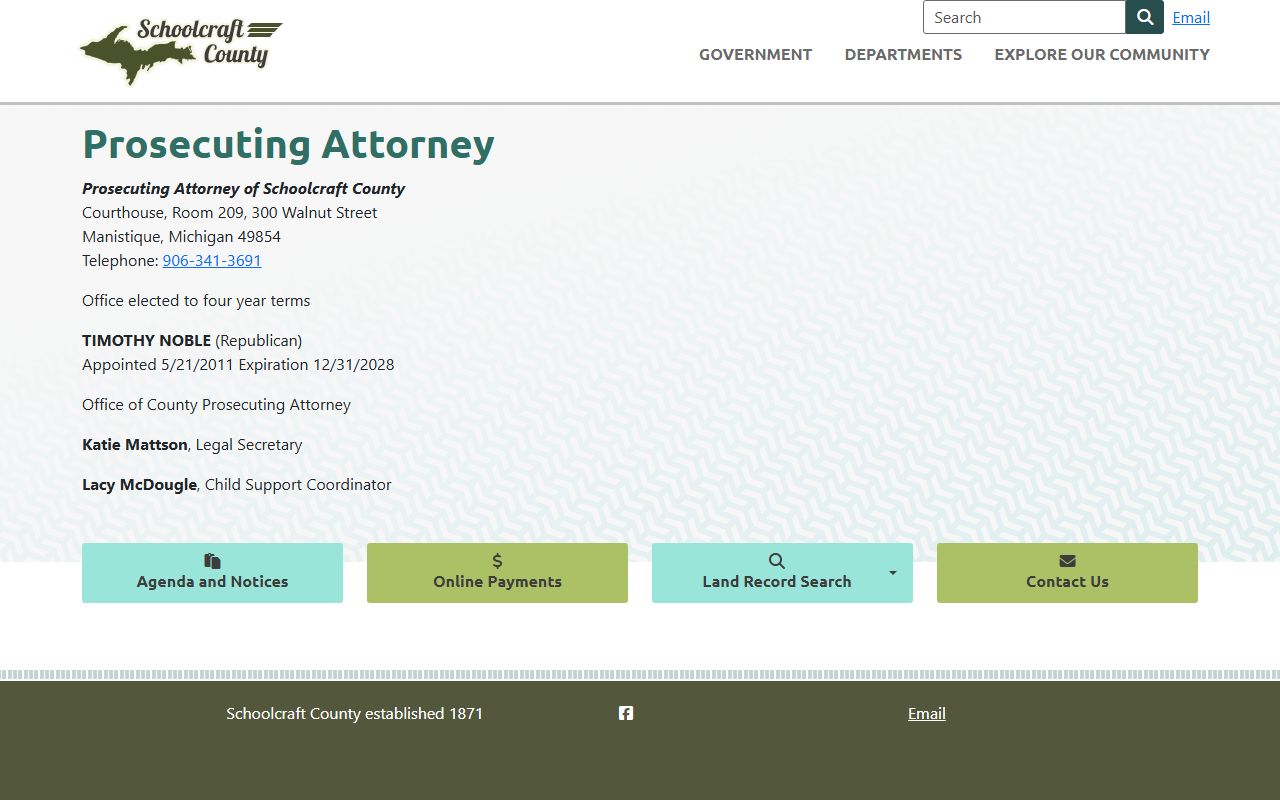
The office page confirms the charging authority that turns a Schoolcraft County arrest into a court charge. Questions about whether a charge was filed, amended, or declined go to this office rather than to the arresting agency. The contact card in the sidebar carries the room number and direct line.
How Charges Get Filed: Complaint, Information, and Indictment
The charge record begins when the prosecutor files a charging document with the court. That paper names the accused, states each offense, and cites the statute. Michigan uses three main charging documents. Which one appears depends on the seriousness of the offense and the stage of the case. Most Schoolcraft matters start with a complaint in the 93rd District Court, and felonies move to the 11th Circuit Court on an information after a preliminary examination.
| Complaint | Information | Indictment | |
|---|---|---|---|
| Filed By | Officer or prosecutor | Prosecutor | Grand jury |
| Common For | Misdemeanors and early felony stages | Felonies after bindover | Rarely used serious felonies |
| Where It Lands | 93rd District Court | 11th Circuit Court | Circuit Court |
| Starts | The case | The circuit case | The case |
In a small county like Schoolcraft, the complaint and the information carry almost all criminal charges. A grand jury indictment is uncommon at the local level. Once the charging document is filed, the charge shows up as a case in the court index and can be looked up by name or case number.
How to Find Schoolcraft County Arrest Records and Charges
The main public tool for the charge side is MiCOURT Case Search, the statewide trial-court index. The county circuit and district court pages link straight into it. MiCOURT shows the case number, party names, case history, and charge information for participating courts, but it is an index rather than a document library. Booking detail from the arrest still comes from the jail, not from this portal.
- Open MiCOURT Case Search, or use the direct county routes for the 11th Circuit Court and the 93rd District Court.
- Search by defendant name, or by case number when it is known, which is the cleanest path.
- Open the case and read the charge list, noting the court, case type, and filing date.
- Check each charge for its statute code, level, and current status, since one arrest can carry several separate charges.
Under Michigan Court Rule 8.119, public online access is limited to case numbers, party names, and the register of actions. Document images are generally not posted, so full copies and certified charge records come from the court clerk. For copies, call the Circuit Court at 906-341-3655, the District Court at 906-341-3630, or the Clerk at 906-341-3618.
Charge Codes and Severity Levels
Every charge on a Schoolcraft County record ties to a specific Michigan statute, usually shown as an MCL number. The code identifies the exact offense, and the level tells you how serious it is. A single arrest can generate several charges at different levels, so one record may list a felony and a misdemeanor side by side. Reading the level is the fastest way to gauge which court will handle the matter.
- Felony
- A serious offense generally punishable by more than one year. Felonies start in the 93rd District Court and move to the 11th Circuit Court after bindover.
- Misdemeanor
- A less serious crime, usually punishable by up to one year. Misdemeanors are handled in the 93rd District Court.
- Civil infraction
- A non-criminal violation, often traffic-related, decided in district court without a conviction on a criminal record.
The charge label on a record is not the whole story. A charge can be attempted, conspired, or solicited, and each of those flags can change the level. The statute cite next to the charge is the reliable anchor when a description looks unclear.
Charge Status After a Schoolcraft County Arrest
Charges rarely stay frozen. As a case moves, the prosecutor and court can amend, reduce, add, drop, or dismiss them. The status field on a charge record tells you where each count stands right now, which matters because an old arrest may show charges that were later reduced or thrown out entirely. The terms below appear on Michigan court records and describe what happened to a count.
| Status | What It Means |
|---|---|
| Pending | The charge is filed and the case is still open, with no final outcome yet. |
| Amended | The prosecutor changed the charge, often to fit the evidence or a plea agreement. |
| Reduced | The charge was lowered to a less serious offense, such as a felony dropped to a misdemeanor. |
| Dropped | The prosecutor stopped pursuing that count, sometimes as part of a deal on another charge. |
| Dismissed | The court ended the charge, which can happen with or without prejudice to refiling. |
| Nolle Prosequi | A formal notice that the prosecutor will not pursue the charge further. |
A dismissed or dropped charge does not always vanish from public view right away. It may remain on the case history until a set-aside or automatic clearance removes it, which is a separate legal step covered further down.
Deferral and Problem-Solving Courts in Schoolcraft County
Some charges follow a path that can keep them off a public conviction record. Michigan law lets certain defendants enter a deferral or problem-solving program, complete its terms, and have the charge discharged and dismissed. The record of participation is often kept nonpublic. These options run through the same courts that handle the charge, and eligibility is decided case by case.
One example is domestic-violence deferral. The Michigan domestic-violence deferral statute, MCL 769.4a, allows a first-time eligible defendant to be placed on probation without an immediate conviction entered, with dismissal on successful completion.
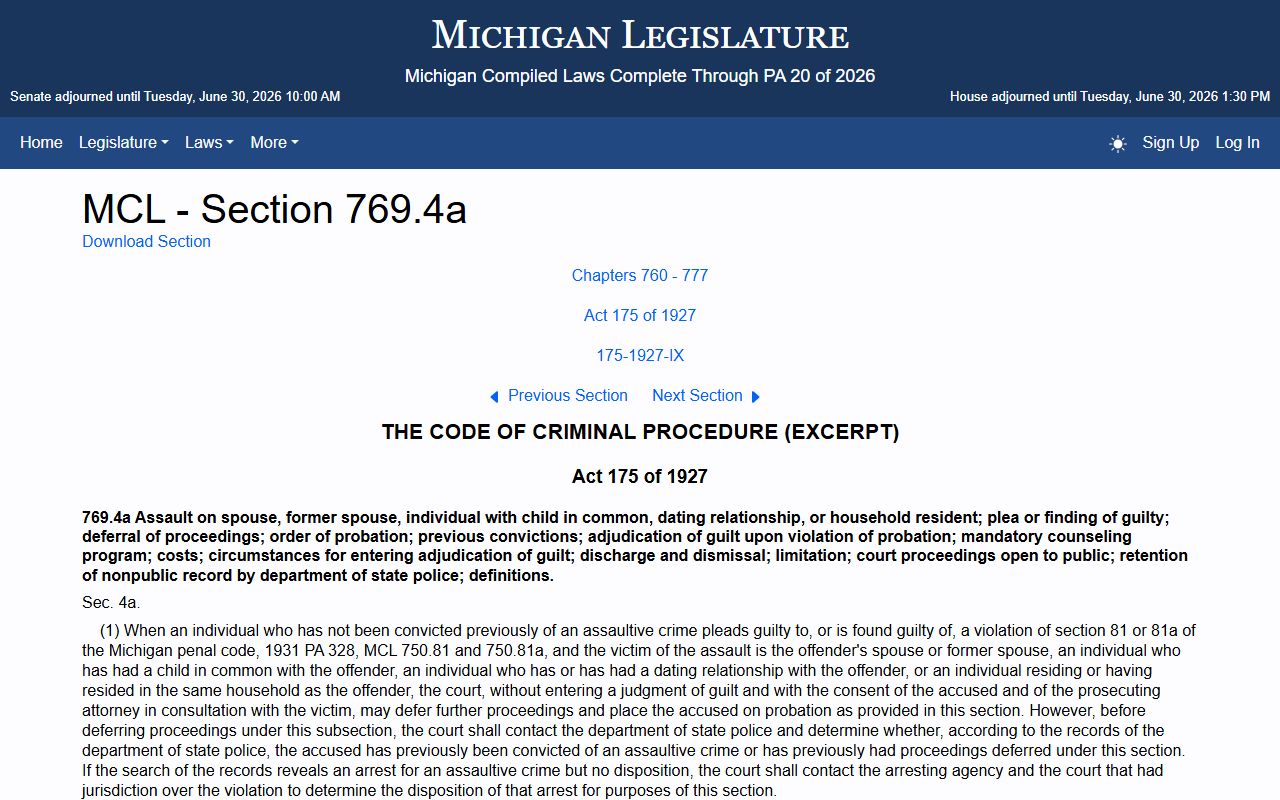
Because the statute allows the charge to be dismissed after probation, a matter that started as an arrest may not end as a conviction. The deferral option is one reason a charge record and a criminal-history report can look different for the same person.
Drug treatment court is a second track. The Michigan drug treatment court statute, MCL 600.1076, authorizes a supervised program with discharge and dismissal for participants who complete it. Schoolcraft is served regionally by the Schoolcraft/Alger Hybrid DWI/Drug Court run through the 93rd District Court.
That regional hybrid court focuses on substance-use and impaired-driving cases. Eligibility, program length, and referral come from the district court, since the county does not publish a separate program handbook.
Veterans have their own track under state law. The Michigan veterans treatment court statute, MCL 600.1209, sets up a program with discharge and dismissal for eligible veterans who finish it.
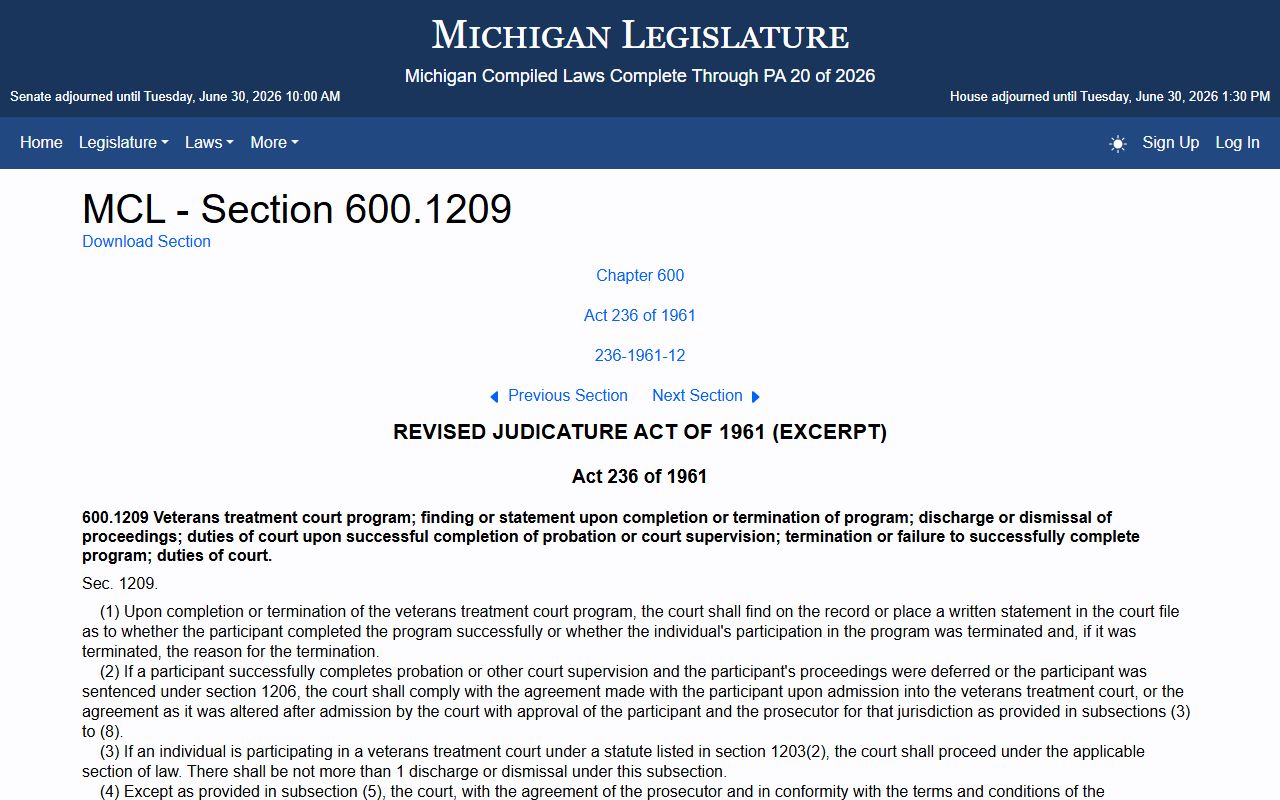
No official source confirms a veterans court based in Schoolcraft County, so a veteran defendant should ask the court whether a regional program applies. The Eastern Upper Peninsula Mental Health Court, which serves Alger, Luce, and Schoolcraft Counties, is another regional problem-solving option tied to the district court.
Charges vs. Convictions in Schoolcraft County
Seeing a charge on a record does not mean a person was found guilty. A charge is only an accusation. A conviction is the outcome after a plea or a trial. This distinction matters when reading any arrest-to-charge record, because a charge can be dismissed, reduced, or resolved through a deferral program without ever becoming a conviction.
| Charge | Conviction | |
|---|---|---|
| Stage | Accusation filed after arrest | Verdict or accepted plea |
| Burden of Proof | Probable cause | Beyond a reasonable doubt |
| Who Decides | Prosecutor | Judge or jury |
| Public Record | Yes, unless restricted | Yes, unless set aside |
The presumption of innocence sits behind this table. Until a court enters a conviction, an open charge is just a pending accusation, and the record should be read that way.
Statewide Charge and Criminal History Lookups
Beyond the county case index, two statewide tools help fill in a charge or criminal-history picture. The Michigan State Police runs ICHAT, a paid name-based criminal history search. It is useful, but it is not complete. ICHAT does not include warrants, traffic records, juvenile records, federal records, tribal records, local misdemeanors, or out-of-state records, so it should never be treated as a full account of every charge a person has faced.
For custody and supervision status, the Michigan Department of Corrections offers OTIS. It covers people under state prison, parole, or probation jurisdiction, along with those discharged within roughly three years. The MDOC OTIS overview explains coverage and search rules, and a profile can list the committing offense, MCL number, status, and location.
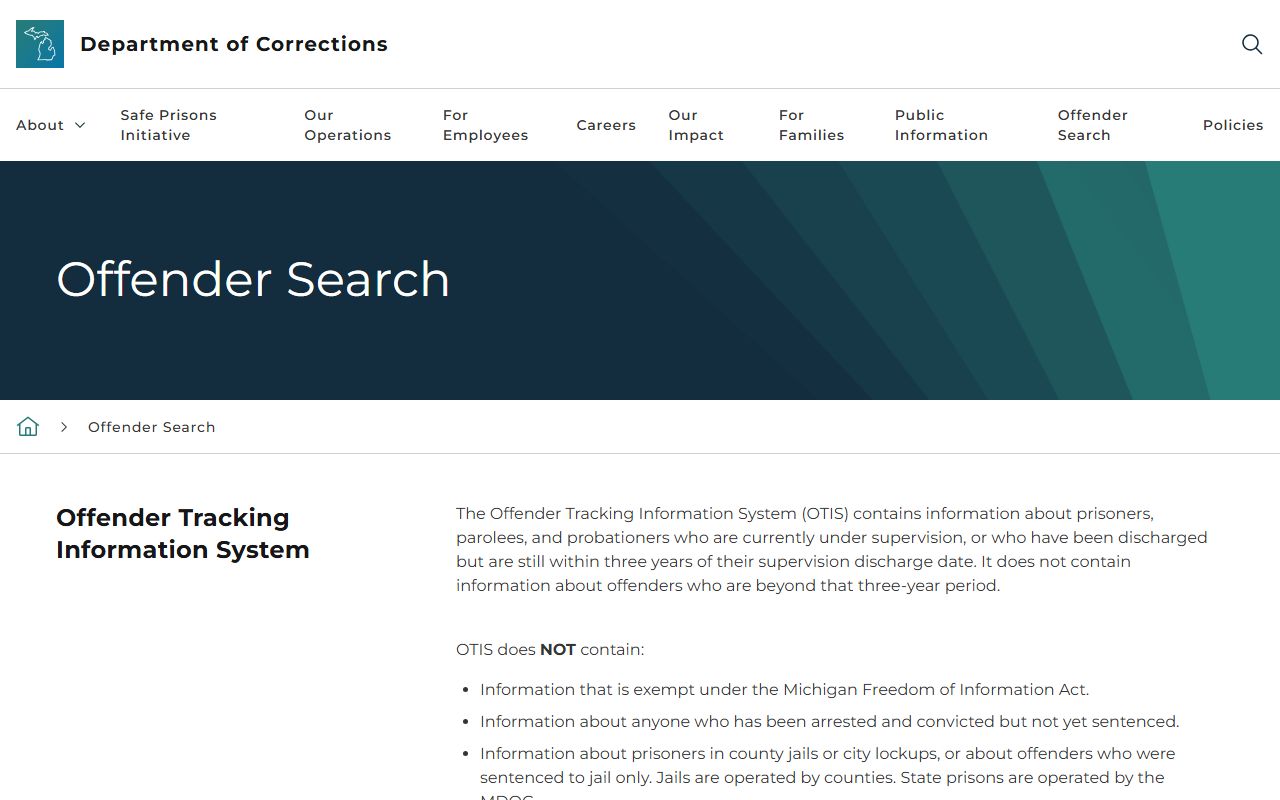
OTIS reaches only state-level custody, so it does not show a Schoolcraft County jail booking or a case that stayed in local court. For a name that never went to state prison or supervision, the county case index and the court clerk remain the better sources. The MSP criminal history page spells out the ICHAT limits in full.
Restricted Charge Records in Schoolcraft County
Not every charge is open to the public. Juvenile charges are limited-access under Michigan law and the state's nonpublic court-record chart. Sealed and set-aside cases drop out of ordinary public search, and some dismissed charges are withheld. Ongoing investigations and sealed search warrants are also kept out of public view. Protected personal details such as dates of birth and Social Security numbers are redacted under Michigan Court Rule 1.109.
Michigan uses set-aside language for many expungements. Under the state's adult set-aside statute, an eligible person applies in the court that entered the conviction, and after Michigan State Police reporting the court can order the record set aside. Some Clean Slate set-asides now happen automatically. A comparison helps show how sealing and expungement differ in practice.
| Sealed | Set Aside / Expunged | |
|---|---|---|
| Public Visibility | Hidden from public search | Removed from public view |
| Law Enforcement | Limited access remains | Nonpublic record retained by MSP |
| How It Happens | By rule or court order | By application or automatic Clean Slate |
Note: A set-aside conviction stays available to courts, licensing bodies, and law enforcement for limited statutory purposes even after it leaves public view.
Background Check Considerations
A casual charge lookup and a formal background check are not the same thing. Reading a public case index or an ICHAT report for personal knowledge is one activity. Using someone's arrest or charge history to decide on employment, housing, credit, or insurance is a regulated purpose governed by the federal Fair Credit Reporting Act, which requires an approved consumer reporting agency and specific consumer protections.
Important: This site is not a consumer reporting agency under the FCRA, and its information cannot be used for employment, tenant, credit, or insurance screening decisions.