
Criminal Court Records in Schoolcraft County
A criminal court record is the case file a court opens the moment a charge is filed. It carries the register of actions, the charging document, every plea and motion, the hearing history, the verdict or plea outcome, and the sentence. In Schoolcraft County these files live at the county courthouse at 300 Walnut Street in Manistique. The elected Clerk of the Court also serves as Clerk of the 11th Judicial Circuit Court, so circuit felony files run through that office, while the 93rd Judicial District Court keeps its own criminal files.
Two trial courts share the criminal work. The 93rd Judicial District Court handles misdemeanors and the early stages of every felony, meaning the arraignment, the probable cause conference, the preliminary examination, and the bindover decision. The 11th Judicial Circuit Court holds the felony case file after a defendant is bound over for trial. Because of that split, the same person can appear in a district file and a circuit file for one arrest. The charges themselves are covered more closely in the Schoolcraft County court charge records, while the full set of case types is grouped under Schoolcraft County court records.
How to Search Schoolcraft County Criminal Court Records
The main public search tool is MiCOURT Case Search, the statewide Michigan Courts index. The county circuit page links straight to the 11th Circuit route, and the district page links to the 93rd District route. MiCOURT shows index and register of actions data, not scanned documents. Michigan Courts rules limit online public access to case numbers, party names, and case history.
- Pick the right court first. Misdemeanors and early felony steps sit in the 93rd District Court; felony trial files sit in the 11th Circuit Court.
- Open MiCOURT from the county court page or the statewide portal, then search by defendant name or by case number when you have it.
- Narrow the results by court, case category, filing date, or offense date to find the right criminal case.
- Open the case to read the charges, the register of actions, the disposition, and any sentence entered.
- Request a certified copy from the clerk that holds the file when you need the official document.
For a statewide name-based criminal history rather than a single case, the Michigan State Police runs a paid search called ICHAT. It is a different product from the court file and it leaves out several record types, which is covered further below.
Stages of a Criminal Case in Schoolcraft County
A criminal case moves through set steps, and each step leaves an entry in the court record. Reading the register of actions in order shows where a case stands and what happened at every appearance. In Schoolcraft County the early steps play out in the district court, and a felony that survives the preliminary examination shifts to the circuit court for the rest of the case.
Case flow: Charges Filed › Arraignment › Pretrial / Preliminary Exam › Plea or Trial › Disposition › Sentencing
| Stage | What Happens |
|---|---|
| Arraignment | The defendant hears the charges and rights in district court, enters an early plea, and the judge or magistrate sets bond. |
| Pretrial / Preliminary Exam | Misdemeanors move through pretrial conferences; felonies get a probable cause conference and a preliminary examination, then a bindover to circuit court if probable cause is found. |
| Plea or Trial | The case ends by plea or goes to a bench or jury trial, where a verdict of guilty or not guilty is entered. |
| Sentencing | After a plea or a guilty verdict, the judge imposes jail, prison, probation, fines, costs, or restitution, and the terms are recorded. |
Note: A single arrest can create both a district court file for the early stages and a separate circuit court file once a felony is bound over for trial.
What a Schoolcraft County Criminal Court Record Shows
A criminal case file is built from many fields, and knowing what each one means makes the record readable. Michigan Court Rule 1.109 defines what counts as a court record and protects certain personal identifiers, so birth dates, Social Security numbers, and account numbers are limited even in an otherwise public file. The visible fields still give a clear picture of the charge, the parties, and the outcome.
| Field | What It Shows |
|---|---|
| Case Number | The unique file number assigned by the court; the format differs between the district and circuit courts. |
| Court | Whether the file sits in the 93rd District Court or the 11th Circuit Court, plus the judge of record. |
| Defendant | The charged person, listed with any attorney of record shown in the public file. |
| Charges | The offense description, the Michigan statute or MCL citation, the charge level, and any attempt or conspiracy flag. |
| Plea | How the defendant answered each charge: guilty, not guilty, or no contest. |
| Register of Actions | The dated list of filings, hearings, motions, orders, and notices from opening to close. |
| Disposition | The current or final outcome of each charge, such as dismissed, convicted, acquitted, or bound over. |
| Sentence | The jail or prison term, probation length, fines, costs, and restitution ordered after a conviction. |
Charges vs. Convictions in Schoolcraft County Records
Being charged is not the same as being convicted, and a criminal record shows both. A file can list charges that were later dropped, dismissed, reduced, or that ended in an acquittal. A conviction only exists once a defendant pleads guilty or no contest, or a judge or jury finds guilt. Reading the disposition field before drawing a conclusion is the safest habit.
| Charge | Conviction | |
|---|---|---|
| Stage | Accusation filed by the prosecutor | Verdict or accepted plea |
| Burden of Proof | Probable cause | Proof beyond a reasonable doubt |
| Reversible | Can be dropped, reduced, or dismissed | Stands unless appealed or set aside |
| Public Record | Yes, in the case file | Yes, in the case file |
How an arrest becomes a reportable record is set by state law. The arrest reporting statute (MCL 28.243) governs how fingerprints and dispositions are collected and when arrest data can be expunged or destroyed.
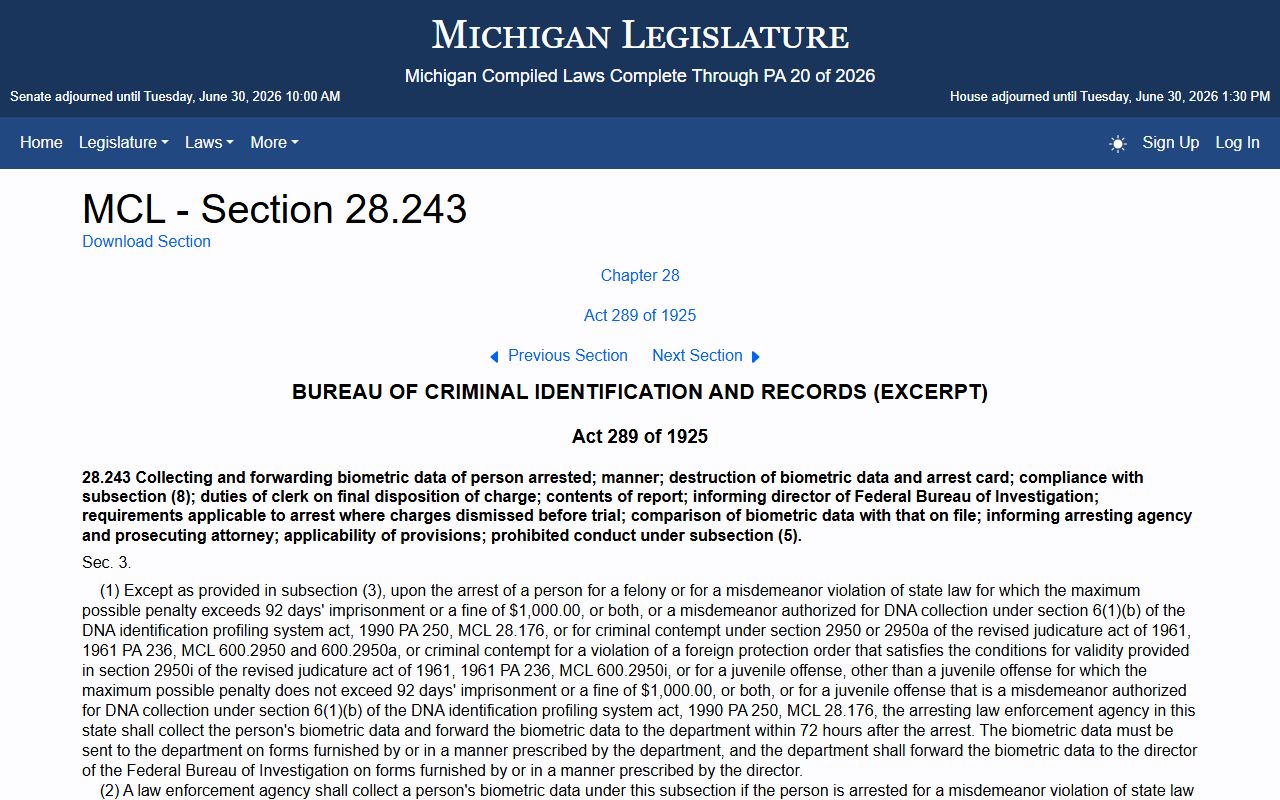
Because that reporting chain feeds both the court file and the state criminal history, a dismissed charge and a conviction can look similar in a name search until the disposition is checked.
Reading Dispositions and Sentences
The disposition is the outcome line, and the sentence is what follows a conviction. Michigan case files use a short set of terms that repeat across nearly every criminal matter. Learning them makes any Schoolcraft County criminal record easier to read at a glance.
- Guilty plea
- The defendant admits the charge, and the court enters a conviction without a trial.
- No contest
- The defendant does not fight the charge; the court treats it as a conviction for sentencing.
- Dismissed
- The charge is dropped by the court or the prosecutor and does not become a conviction.
- Acquittal
- A judge or jury finds the defendant not guilty after trial.
- Disposition
- The final or current result of a charge, entered in the register of actions.
- Sentence
- The jail, prison, probation, fine, cost, or restitution ordered after a conviction.
A sentence entry can bundle several parts at once. The record may list a jail term, a probation period, court costs, a fine, and restitution to a victim on the same charge.
The Prosecutor and Defense in Schoolcraft County Cases
Charges do not come from the court. They come from the Prosecuting Attorney, who reviews police work and decides what to file on behalf of the state. In Schoolcraft County that office is led by Timothy Noble, the Prosecuting Attorney, who handles felonies, misdemeanors, and related matters in both trial courts. The prosecutor is the party listed against the defendant in the case caption.
County Courthouse, Room 209
300 Walnut Street, Manistique, MI 49854
906-341-3691
A defendant who cannot afford a lawyer may qualify for appointed counsel through the court and the state indigent defense system. Eligibility is usually raised at arraignment, and the Schoolcraft County Public Defender Office, run by Kathryn Denholm at 218 Oak Street in Manistique, 906-341-7628, is one contact for defense representation. The court decides appointment; the record notes counsel of record for each party.
ICHAT Versus the Court File
People often confuse the state criminal history with the court case file. The Michigan State Police ICHAT service is a paid, name-based search of Michigan felony and serious misdemeanor convictions. It is not the same as the court file, and it deliberately leaves out large categories of information.
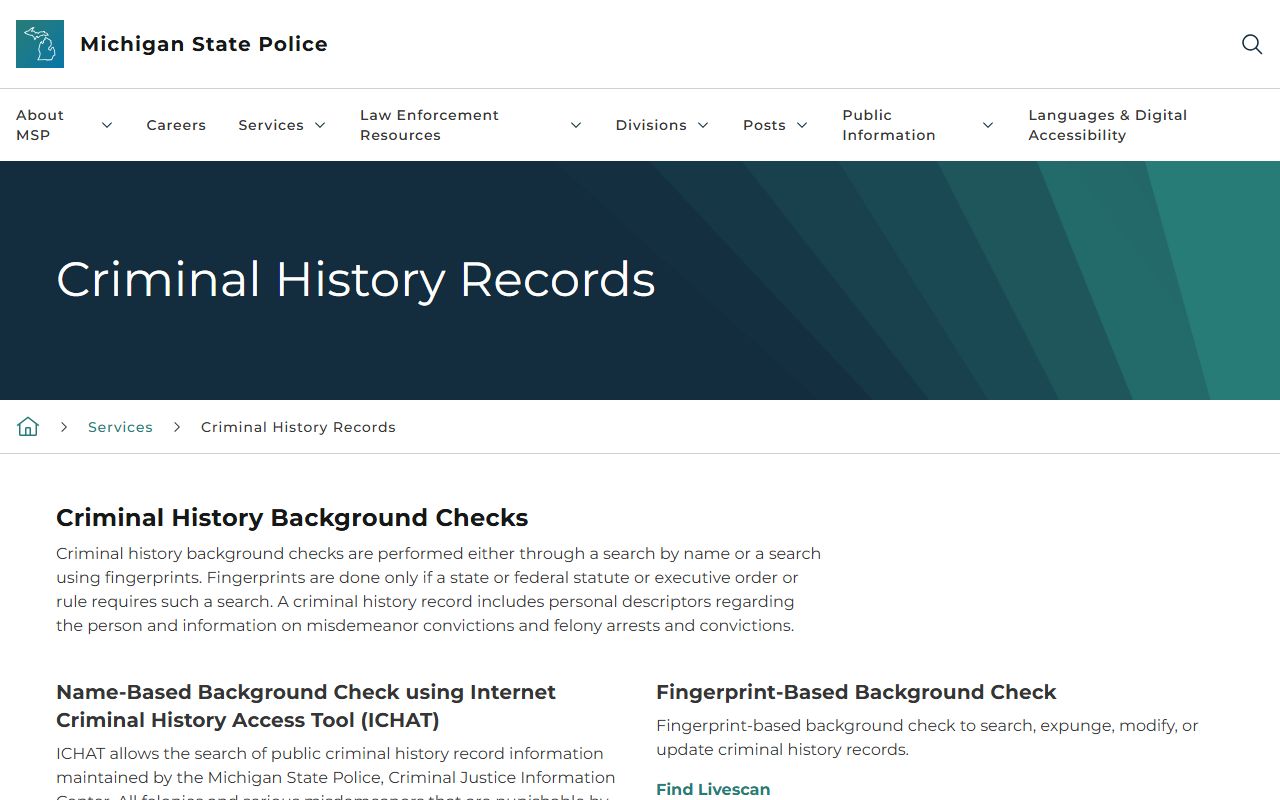
ICHAT reports name-based conviction data statewide, but it excludes warrants, traffic offenses, juvenile records, federal cases, tribal cases, most local misdemeanors, and out-of-state records. The Schoolcraft County court file, by contrast, holds a single case in full, including pending charges and dispositions that ICHAT will not show.
| ICHAT (MSP) | Court Case File | |
|---|---|---|
| Scope | Statewide conviction history by name | One case in one court |
| Cost | Paid, per search | Free to view the index on MiCOURT |
| Excludes | Warrants, traffic, juvenile, federal, tribal, local misdemeanors, out-of-state | Nonpublic and sealed material only |
| Best For | A background-style history | Reading one charge, plea, and outcome |
Important: A casual name lookup is not a consumer report under the Fair Credit Reporting Act, and results cannot be used for employment, credit, tenant, or insurance screening decisions.
Setting Aside a Schoolcraft County Criminal Conviction
Michigan does not use the word expunge in its statutes. It uses the term set aside. When a conviction is set aside, it is removed from public view, though it stays available for limited law enforcement, court, and licensing purposes. The adult set-aside statute (MCL 780.621) lists which convictions qualify and how many a person may clear.
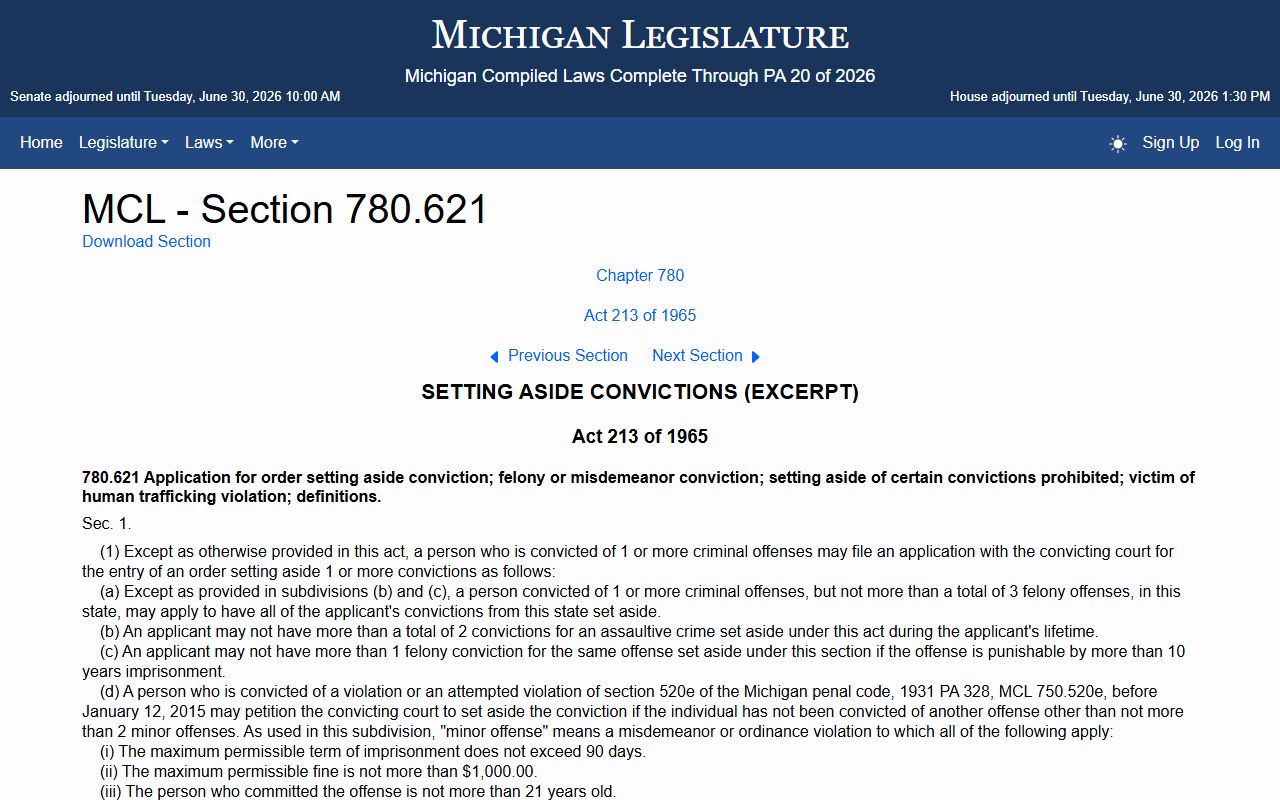
An application-based set-aside is filed in the court that entered the conviction, so a district conviction is filed in the 93rd District Court and a circuit conviction in the 11th Circuit Court. The person identifies eligible convictions, completes the state process, serves the prosecutor and required agencies, and waits for Michigan State Police reporting before a judge can sign the order.
Clean Slate: Michigan's automatic set-aside law took effect on April 11, 2021, and some eligible convictions clear on their own, but a person may never receive notice that it happened.
Nonpublic Criminal Records After a Set-Aside
A set-aside does not erase every trace of a case. It changes who may see it. The nonpublic record rule (MCL 780.623) directs the Michigan State Police to keep a nonpublic record of a set-aside conviction. That record is available only to courts, law enforcement, and certain licensing bodies named in the statute.
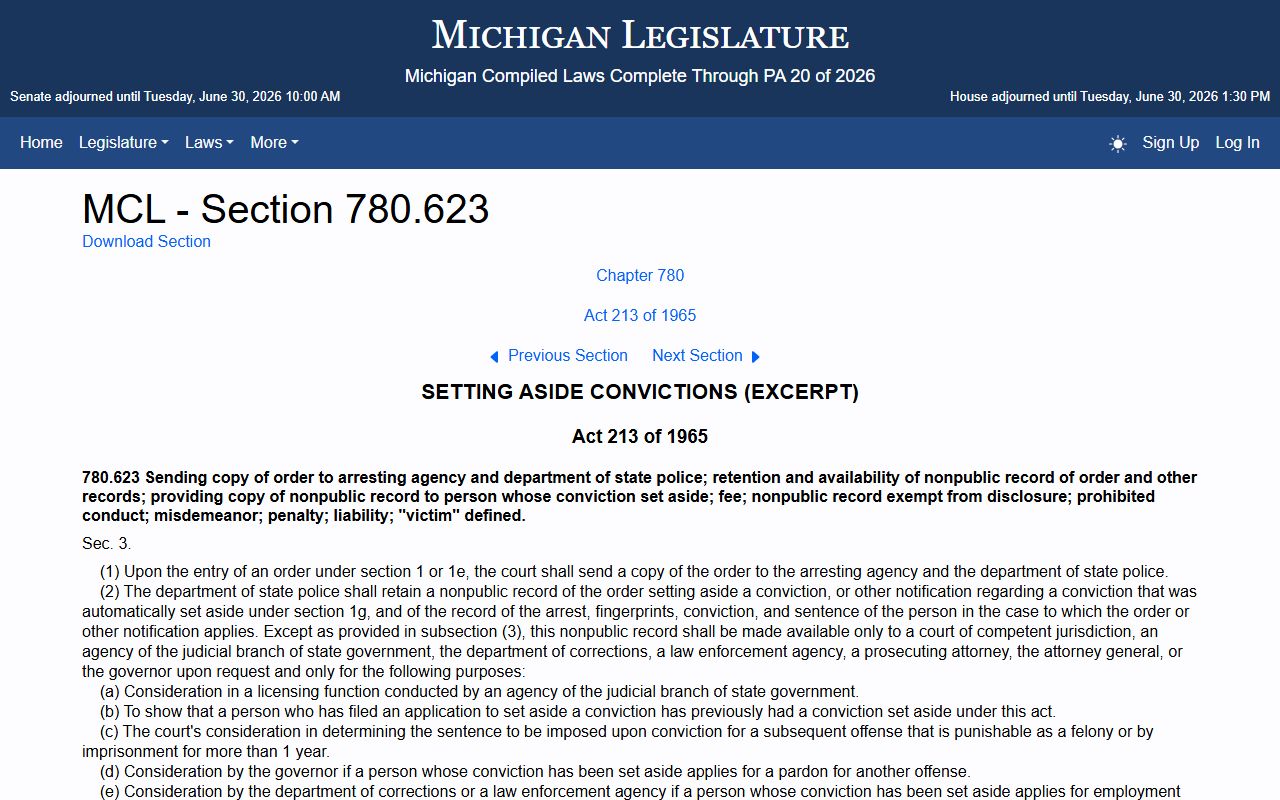
For the public, this is the practical difference between sealed and truly gone. A set-aside conviction should not appear as an ordinary conviction in a public case search or on ICHAT, yet it is not destroyed. Contrast that with the destruction of some arrest biometric data allowed under the arrest reporting law, which removes the data itself rather than hiding it.
Sealed vs. Set Aside Records
The words sealed, expunged, and set aside get used loosely, but they mean different things in Michigan. Sealing hides a record from public view while it still exists. A set-aside is Michigan's version of expungement, and after it a nonpublic record survives for limited official use. True destruction, where the data no longer exists, is narrower and applies mostly to certain arrest information.
| Sealed | Set Aside (Michigan) | |
|---|---|---|
| Visibility | Hidden from the public | Removed from public criminal history |
| Law Enforcement | Limited access | Nonpublic record retained by MSP |
| Eligibility | By court rule or specific order | Per MCL 780.621, with waiting periods and caps |
| Where Filed | The court holding the file | The court that entered the conviction |
Youthful Trainee Deferrals in Schoolcraft County
Some cases never become a public conviction at all. The Holmes Youthful Trainee Act (MCL 762.14) lets a court assign trainee status to certain young defendants. If the person completes the terms, the case is discharged and dismissed, and the record is kept nonpublic rather than entered as a conviction.
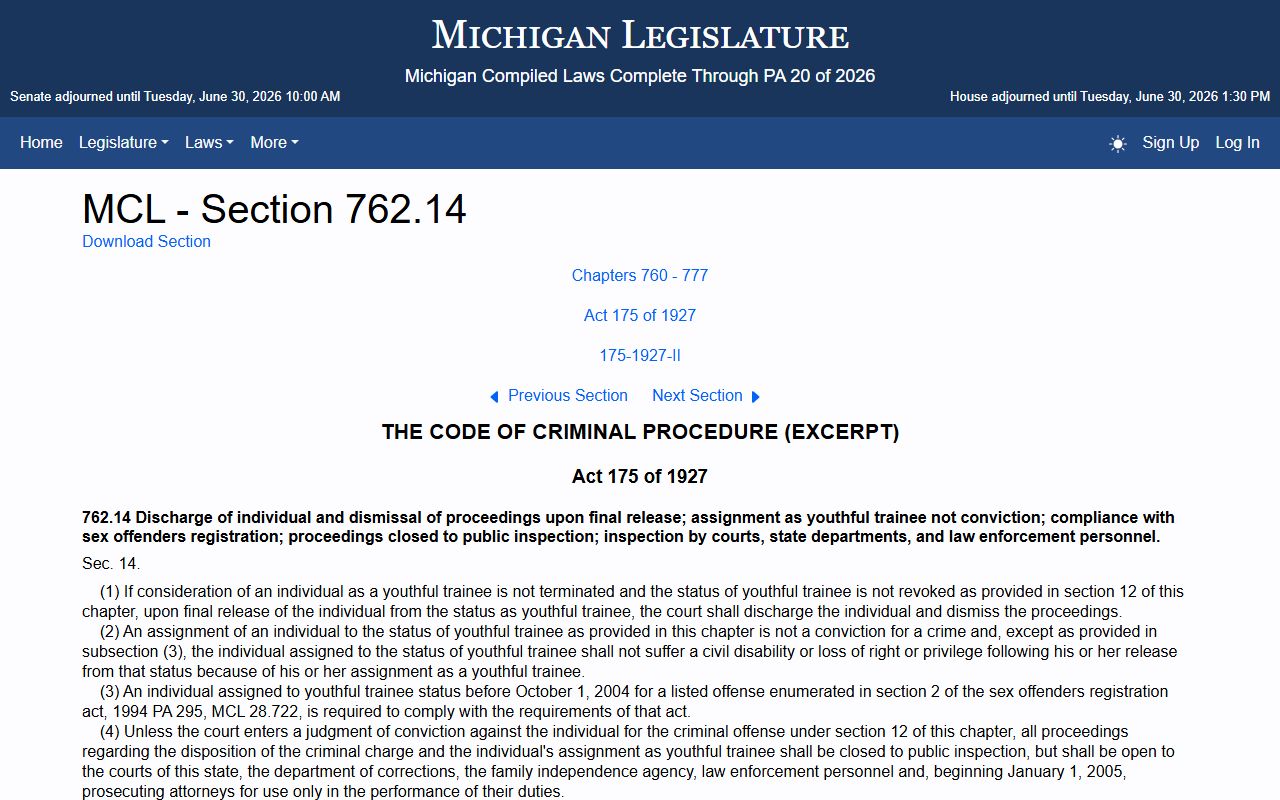
Because the outcome is nonpublic, a HYTA case may not show up in an ordinary Schoolcraft County criminal record search even though the court handled it. A failed trainee status, on the other hand, can convert to a normal conviction and appear like any other case in the file.
Controlled Substance Deferrals and Court Records
Michigan offers a similar path for eligible drug cases. The controlled substance deferral statute (MCL 333.7411) allows a first-time offender to be placed on probation without a judgment of guilt being entered. Complete the probation, and the charge is dismissed with no public conviction.
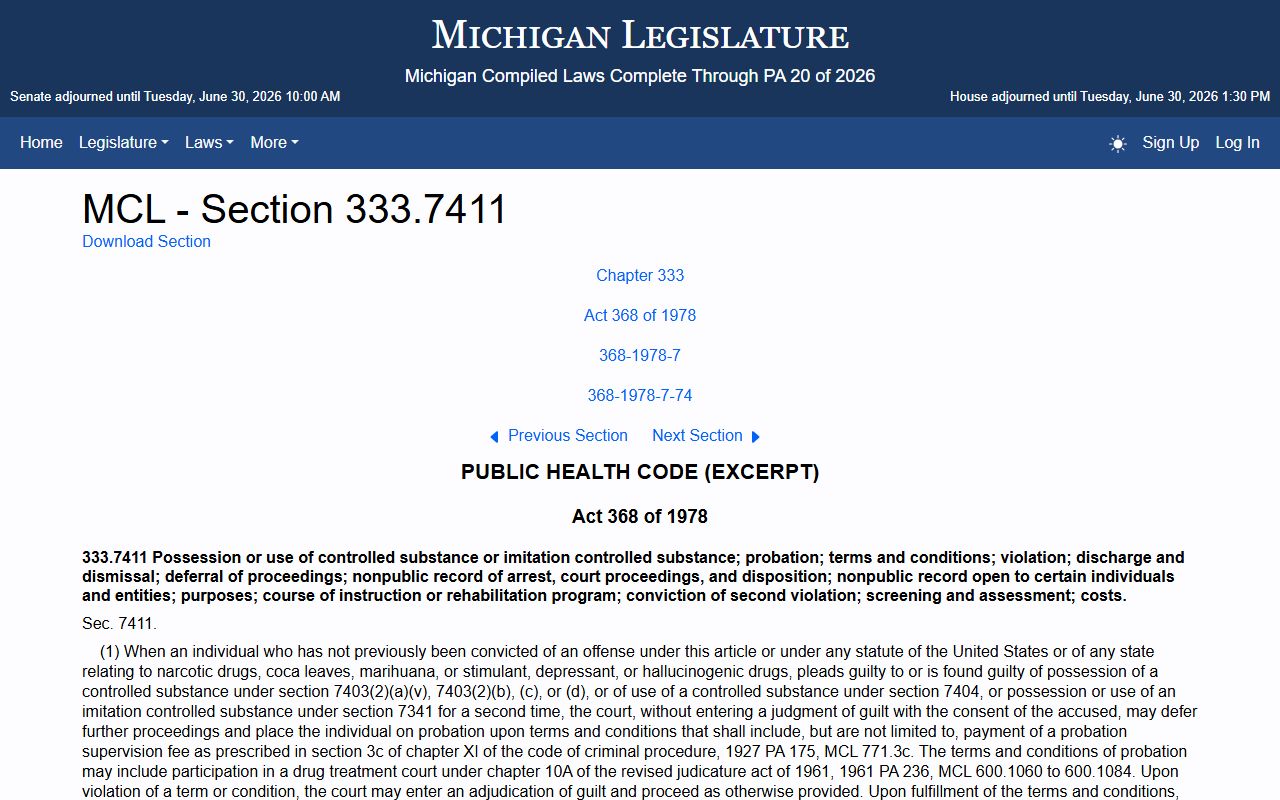
The court still keeps a nonpublic record of the deferral so it can be used if the person qualifies again. These diversion outcomes are one reason a court file and a public criminal history can disagree, and why the disposition line matters more than the charge line.
Public Access to Criminal Court Records
Most adult criminal case files in Schoolcraft County are public. Access runs through court rules rather than the general open-records law, because court case files sit outside routine county records requests. County administrative and sheriff records use the Michigan FOIA process instead, while the court file itself is governed by the Michigan Court Rules.
Key Rules and Statutes:
Michigan FOIA (MCL 15.231) declares a public policy of access to government records, though court case files are handled under court rules.
Arrest reporting (MCL 28.243) sets how arrests and dispositions are reported and when arrest data may be destroyed.
To read only the index, MiCOURT is free. For a complete document or a certified copy, the request goes to the court that holds the file. Michigan Court Rules generally keep scanned document images off the public internet, so the certified copy is the reliable way to get the full paper.
Requesting Copies and Certified Copies
A certified copy is a copy the clerk authenticates for official use, and courts require it for many legal purposes that a plain printout cannot serve. In Schoolcraft County the request goes to the office that holds the file: the 93rd District Court at 906-341-3630 for its criminal matters, and the Circuit Court or Clerk of the Court at 906-341-3655 or 906-341-3618 for circuit felony files. The published county fee schedule sets the circuit court copy and certification charges.
| Item | Fee |
|---|---|
| Circuit Court copy of a document already filed | $1.00 |
| Circuit Court copy prior to filing | $0.30 |
| Circuit Court certification | $10.00 |
| Circuit Court record search, per name | $10.00 |
District court copy charges are confirmed by calling the 93rd District Court, since the county fee schedule details the circuit court and clerk fees. Payment goes to the court office, and the Clerk of the Court counter sits in Room 164 at the courthouse.
Restricted Criminal Court Records in Schoolcraft County
Not every criminal matter is open. Michigan law and court rules pull several categories out of public view, and a public search will not return them. Anyone who is a party, an attorney, a parent or guardian, or has a court order should contact the court directly for these files.
- Juvenile delinquency and child-protection cases handled through the probate and family side of the courts.
- Convictions that have been set aside, which become nonpublic under state law.
- Cases resolved through youthful trainee status or a controlled substance deferral that end in a nonpublic discharge.
- Sealed matters, search warrants during an active investigation, and mental health proceedings.
- Protected personal identifiers such as birth dates, Social Security numbers, and account numbers under Michigan Court Rule 1.109.
Note: A person seeking a restricted file should confirm eligibility and the correct court by phone before traveling to the courthouse counter in Manistique.